Patients don’t just Google a physical therapist anymore. They ask ChatGPT for a recommendation, read the AI summary at the top of the results page, and ask Siri who’s best nearby. If a clinic isn’t showing up across all of those surfaces, it’s invisible to a growing share of people actively looking for care.
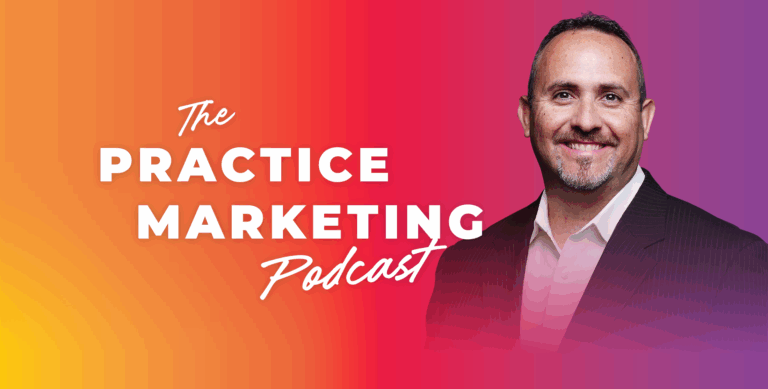
In this episode of the Practice Marketing Podcast, Neil Trickett, PT and CEO of Practice Promotions, lays out the Practice Search Visibility Blueprint: the five pillars of search optimization every PT owner needs as AI reshapes how patients discover clinics. It’s the same framework Practice Promotions runs for its own clients.
📄 Download the Practice Visibility Blueprint and follow along with Neil.
🎥 Register for this month’s Ultimate PT Marketing Workshop, a live monthly Zoom session where you can ask Neil questions directly.
Episode Highlights
- → Why traditional Google ranking is no longer enough
- → Pillar 1: Google Local & Search Optimization
- → Pillar 2: Search Engine Marketing (SEM)
- → Pillar 3: AI Search Optimization
- → Pillar 4: Answer Engine Optimization
- → Pillar 5: Social Search Optimization
About the Presenter
Neil Trickett, PT, is the host of the Practice Marketing Podcast and CEO of Practice Promotions, which provides marketing exclusively for physical therapy and chiropractic practices.
Key Takeaways
- Ranking on Google isn’t enough. Visibility now spans Maps, voice search, AI summaries, and social.
- Your Google Business Profile is an ad platform. Treat it like one.
- SEM buys instant presence. SEO compounds over time; paid search fills the gap right now.
- Format for answers, not just keywords. Winning the AI answer wins the patient.
- Social is now search. Optimized social confirms credibility and gets indexed by Google directly.
The New Era of Patient Discovery
Neil opens with the core shift: “It’s no longer enough just to be ranked on Google.” Patients now search across multiple platforms at once, tapping “near me” on Google Maps, asking Siri or Alexa for the best provider nearby, scrolling Instagram or Facebook for health content, and increasingly turning to AI tools like ChatGPT, Gemini, and Claude to ask who they should see for a pain, injury, or condition.
He walks through why this happened so fast. ChatGPT launched in November 2022 and hit a million users in five days; Claude, Gemini, Copilot, and Grok followed through 2023. In May 2024, Google rolled out AI Overviews at the top of search results, so instead of clicking through links, patients increasingly just read the AI summary. As Neil puts it, “if your clinic is not in the AI summary, you could be missing out.” Then in July 2025, Google announced it would start indexing Instagram posts directly into search, including into that AI Overview, which means social search optimization stopped being optional.
Neil calls this the biggest shift in marketing since websites became mainstream in the late 1990s. A clinic focused only on traditional SEO is missing the majority of patient discovery happening online today. The goal, as he frames it: be visible at the top of Google and Google Maps, seen on Instagram and Facebook, recommended by Siri in voice search, surfaced in ChatGPT and AI-driven results, and featured as the answer in the AI Overview itself. That’s what the Practice Search Visibility Blueprint, the five pillars below, is built to do. Neil notes this is the same framework his team uses to help position more than a thousand clinics across the US and Canada.
Pillar 1 — Google Local & Search Optimization
This is the foundation, and still the most powerful way patients find a clinic online. The goal is to rank in the top three of the Google Maps section and at the top of the organic results at the same time.
That starts with a Google Business Profile that’s accurate, aligned with real local patient search behavior, and backed by the technical fundamentals: meta titles, schema markup, and mobile performance. As Neil puts it, “you have to see your Google Business Profile as arguably one of your most important online advertising platforms as a local business.” Professional photos that show what the clinic experience is actually like, a steady stream of new Google reviews, and regular posts to the profile all signal to Google that the business is active and trustworthy. On top of that, getting listed consistently across other directories (Waze, Uber, Apple Maps, Bing, Yahoo, the local Chamber of Commerce) reinforces the same signal.
Done well, this pillar means ranking higher for “near me” searches, showing up in the map pack, and bringing in more qualified people who actually convert into new patients. The specific work involved: Google Business Profile optimization, local keyword strategy, optimized meta titles and descriptions, schema markup and on-page SEO, mobile and site-speed optimization, site security, sitemaps and robots.txt files, and mobile responsiveness. It’s technical, and it takes constant upkeep to hold the top spots, which is exactly why Neil frames it as specialist work rather than a one-time setup.
Pillar 2 — Search Engine Marketing (SEM)
Where SEO is the long game, search engine marketing (Google Ads) lets a clinic skip the line and appear at the top of results immediately, especially for high-intent, ready-to-book searches like “physical therapy near me.” It also lets a clinic target specific areas, not just its immediate radius, but surrounding towns, specific zip codes, or higher-income neighborhoods it wants more cash-pay or better-reimbursing patients from.
Neil walks through a real client example: a month of ad spend generated 477 clicks to call or visit the website, of which 46 turned into actual leads (people who requested an appointment by form or by calling), working out to roughly $40 per new patient lead. That kind of tracking, knowing exactly how many calls or bookings came from which campaign, is what makes SEM worth running alongside SEO rather than instead of it.
Pillar 3 — AI Search Optimization
This is where things are heading. AI tools like Google’s AI Overviews and ChatGPT increasingly answer health questions directly, so the goal is structuring a clinic’s content so those tools pick it as the answer: clear formatting, featured-snippet targeting, well-optimized FAQs, and content written the way patients actually talk to AI tools.
The important nuance: AI search tools scrape the internet, and primarily Google itself, to compile their answers. So AI visibility still depends on ranking well in Google and running solid SEM, the first two pillars feed directly into this one. Neil demonstrates this by asking ChatGPT for the best treatment for knee pain in a specific town; the results it surfaces are clinics that already rank well in Google and have deep, condition-specific pages: what he calls condition-based marketing. Those are exactly the pages AI tools scrape and serve up in their answers, which is why detailed, conversational content on conditions a clinic treats matters more than ever.
Pillar 4 — Answer Engine Optimization
Answer Engine Optimization, or AEO, targets the part of Google (and tools like ChatGPT) that gives a single direct conversational answer instead of a list of links: things like Google’s “People Also Ask,” voice assistant answers, and AI chat responses. As Neil puts it, “when you win that featured snippet at the top, you win the patient.”
Winning that spot means writing more conversational, answer-formatted content, primarily on the website and the Google Business Profile, built around long-tail, question-style keywords rather than just short SEO keywords (think “Hey Siri, find physical therapy near me” instead of just “physical therapy”). That means more consistent blogging, deeper condition-specific pages, and schema updated to match FAQ-style content. Done well, it drives zero-click traffic and voice-based leads, and builds authority because the practice shows up everywhere a patient might be asking.
Pillar 5 — Social Search Optimization
The fifth pillar turns Instagram and Facebook into discovery engines in their own right. Patients already use social platforms to search for local providers and health information, and they check a clinic’s social presence to confirm credibility once they’ve found it elsewhere. With Google now indexing Instagram posts directly (as of July 2025), a clinic’s social content can show up in a plain Google search for something like “knee pain treatment,” not just inside the app.
Building this out means profile optimization with correct links back to the website, hashtag strategies built around both conditions and location, video search optimization, and posts tuned to the same keywords the clinic is already targeting with SEO and Google Ads. That way social and search reinforce each other instead of running as separate efforts. Google also factors in engagement (views, interactions) when weighing how to rank that content, so an active, well-run social presence compounds. Done right, it converts followers into website visitors and patients, not just likes.
FAQs
What is search engine optimization for physical therapy practices?
It’s the ongoing work of making a clinic rank well on Google, both in the map/local section and the organic results, through an accurate, fully-built-out Google Business Profile, consistent reviews, and the technical fundamentals (schema markup, meta titles, mobile performance, site speed). It’s the foundation that everything else, including AI visibility, is built on.
How can AI impact patient search behavior in healthcare?
Patients increasingly ask AI tools like ChatGPT or Google’s AI Overview for a recommendation instead of scrolling search results themselves. Since these tools scrape the internet, mostly Google, to build their answers, a clinic that doesn’t rank well or doesn’t have deep, condition-specific content risks being left out of the AI-generated answer entirely, even if it would otherwise be a good fit for that patient.
What are the key elements of practice visibility for PT owners?
The five pillars covered above: Google Local & Search Optimization, Search Engine Marketing, AI Search Optimization, Answer Engine Optimization, and Social Search Optimization. Together they cover every surface a patient might search on: Google, Maps, voice assistants, AI chat tools, and social media.
How do I optimize my physical therapy website for AI searches?
Build out deep, condition-specific pages (back pain, shoulder pain, knee pain, and so on) written in a conversational, question-answering style, since that’s the content AI tools scrape and serve up. Pair that with strong underlying SEO and schema markup, since AI tools lean heavily on how well a site already ranks in Google.
What strategies can I use to improve my clinic’s online presence?
Work all five pillars together rather than picking one: a fully optimized Google Business Profile, Google Ads for immediate visibility, AI- and answer-formatted content, and an active, well-linked social media presence. Practice Promotions’ specialists implement this full blueprint for clients rather than any one piece in isolation.
Related Episodes & Resources
- Related episode: Your 2025 Digital Marketing Plan for PTs & Chiros
- Related episode: Top Trends in PT and Chiro Marketing for 2025
- Related episode: Real AI Tools for Real PT Clinics w/ Rob Helton, DPT
- Digital marketing & SEO services, Practice Promotions’ core digital channel page
- Download the Practice Visibility Blueprint PDF
- Register for the monthly PT Marketing Workshop
Don’t Forget To Subscribe!
You can listen to this episode and subscribe to others anywhere you get your podcasts by clicking here. Or, if you prefer, watch full episodes on YouTube!
PS: See how the right marketing ideas can help you grow your Physical Therapy or Chiropractic clinic.
View Full Episode Transcript (click to expand)
[0:18] Is your practice competitive online? Thousands of searches are being done every day in your area for all kinds of queries about people’s health and wellness. But will your clinic show up? Is it competitive enough, or are you barely visible? Welcome to the new era of patient discovery. As a physical therapy practice owner, you need to understand something critical: the way patients find you has radically changed. It’s no longer enough just to be ranked on Google. Patients now search across multiple platforms simultaneously, and your clinic must be optimized to show up and stand out everywhere they’re looking.
Think about how patients search today. They might tap “near me” on Google Maps, or ask Siri or Alexa for the best provider nearby. They might scroll Instagram or browse Facebook looking for health content and solutions for their pain or problem. And more recently, they’ve turned to AI tools like ChatGPT, Gemini, or Claude, asking for advice on who to see for their pain, injury, or condition.
[1:28] Before I get into the five pillars of online discoverability, first we have to ask: what’s happened? Why has patient behavior online changed? In the past few years, AI chat engines have gone from the stuff of science fiction to part of our everyday lives. In November 2022, OpenAI launched ChatGPT, and in just five days it got a million users. Then we had Claude, Gemini, Copilot, and Grok, which followed in 2023. Now I’m sure you know lots of people, from teachers to PTs to students, who use ChatGPT on a daily basis. This is a seismic change in how we get information, and it’s happened in just the past two years.
In May 2024, Google launched AI Overviews, which appears at the top of Google search. Now, instead of clicking around the top few links for an answer, patients read the AI summaries at the top of Google. So if your clinic is not in the AI summary, you could be missing out. And finally, in July of 2025, Google announced that they’re now going to index Instagram posts, which means Instagram posts are now going to show up at the top of Google searches, included in that AI Overview at the top. So social search optimization is no longer a luxury for your practice.
These are really specific, big changes, and this is the biggest change in marketing since the dawn of the internet and websites became a thing in the late 1990s. Dominating search is a totally different game today. And if your clinic is still focused only on traditional SEO, you’re missing out on the majority of patient discovery online.
So here’s what dominating search looks like for a PT clinic today and beyond. This is your goal, and I’m going to explain how you’ll get there. Online success really means that your practice is visible at the top of all Google and Google Maps. It’s seen by more people on Instagram, Facebook, and social media. It’s recommended by Siri in voice search. Your practice shows up in AI-driven search engines and ChatGPT results. And your clinic name is the featured answer in the AI Overview at the top of Google and ChatGPT. And you know where all your leads are coming from, ideally.
That’s why we created the Practice Search Visibility Blueprint, which includes the five pillars of search optimization that physical therapy practice owners need to know: Google local and search optimization, search engine marketing with Google Ads, AI search optimization, answer engine optimization, and social search optimization. That’s the high-performance framework our team uses to help position over a thousand clinics all across the US and Canada. I’m going to share it with you here today.
[4:52] All right, the first pillar is Google local and search optimization. This is your foundation, and it’s still the most powerful way for people to find your clinic online. Your practice must dominate in Google. The goal is to rank in the top three in the map section and at the top of the organic section. It’s where traditional SEO meets cutting-edge visibility tactics.
First off, you have to ensure your Google Business Profile is accurate, has keyword strategies aligned with local patient search behaviors, and has technical elements like meta titles, schema markup, and mobile performance that are really dialed in for your practice. You have to see your Google Business Profile as arguably one of your most important online advertising platforms as a local business. And you need to show prospective patients what that experience is going to be like at your practice, with professional pictures selling that experience of what it’s like to come to your practice. This should be backed up with consistent, growing Google reviews, and working on categories and posting regular content to the Google Business Profile. This helps signal to Google that you’re a growing, trustworthy business.
Then you have to work to get your business connected with other online directories and sites like Waze, Uber, Apple Maps, Bing, Yahoo, your local Chamber of Commerce, and more. How does this help your clinic? Your clinic ranks higher for “near me” searches, appears in Google’s map pack, and brings in more qualified, interested people who convert into new patients.
Here are some of the areas we focus on to help clinics rank: Google Business Profile optimization, local keyword strategies, optimized meta titles and descriptions, schema markup and on-page SEO, website mobile and speed optimization, site security, sitemaps and robots.txt files, and mobile responsiveness. It sounds like a lot of technical jargon because it is technical, and it takes constant work to battle for the top of Google, which is why you need specialists helping you fight for those top spots.
[9:58] Speaking of the very top of Google and the map section: the second pillar is search engine marketing, which is Google Ads. While SEO is critical for long-term growth, search engine marketing with Google Ads allows your clinic to skip the line and appear at the top of search results immediately, especially for those most valuable, ready-to-book keywords like “physical therapy near me.” It also allows you to specifically target areas in your region and community to show up for searches, which isn’t possible with SEO alone.
Imagine if you could specify to show up not just for your area, but even surrounding towns, or if there’s a more affluent area of your town you want to target, you can specifically have your searches show up there to get more cash or higher-reimbursing patients. That’s the power of leveraging search engine marketing. Whether a patient is searching for “best PT near me for sciatica” or “sports injury rehab near me,” your clinic will show up at the exact right time with search engine marketing.
With Google search engine marketing, you can run specific strategic campaigns with keyword targeting like “sports injury,” “back pain treatment,” or “physical therapy near me.” You can use geo-fencing to target specific areas, use bid management to lower the cost to get a new patient, and use advanced tracking to see exactly how many leads actually become patients, how many calls or bookings came from your campaigns, giving you real transparency and letting you dial things in for better results.
*[Mid-episode ad break: Neil mentions his book, “Market2Grow,” available free at practicepromotions.net/book, for podcast listeners.]*
So why is it so important to use search engine marketing? If you’re not doing Google Ads, or if you are but you’re trying to do it yourself and wasting a lot of money, here’s why it matters: Google Ads lets you be at the very top of Google and in the top of the map section, spots reserved for people paying to advertise. As a clinic, you want to show up as many times as possible in the search results. Google Ads also lets you target a broader range than SEO alone, where you might only show up within a certain radius depending on how dense or urban your area is. If you need to target specific zip codes, different towns, or a more rural area, that’s where Google Ads comes in, along with better tracking and visibility into how those campaigns are actually performing.
Here’s a real client example: over the course of a month, they generated 477 people clicking to call or clicking through to their website to learn more. Out of those, 46 people actually became leads, meaning they requested an appointment through a form or a call. That works out to just about $40 for a new patient lead, which is pretty incredible. Even though you’re spending money on advertising itself, you’re able to get more patients in for less cost per patient, which is why it’s so important to incorporate search engine marketing into your practice.
[14:35] All right, the third pillar is AI search optimization. This is the future. With AI tools like Google’s AI Overviews and ChatGPT answering health questions directly, we structure your content so these tools choose your clinic as the first answer. That means things like clear formatting, featured-snippet targeting, optimized frequently asked questions, and a strategy that reflects how patients actually speak to AI tools.
Through AI searches, you have to realize they scrape the internet, they scrape websites, and primarily they scrape Google as well as other search engines to compile the most relevant information for their searches and for your prospective patients. So it still relies heavily on clinics that rank well in Google and are the authority in their space. It comes back to making sure your practice is ranking really well on Google and is using search engine marketing, and that’s going to show up in those AI searches.
Here’s why it works: it allows you to appear in Google’s AI Overviews and ChatGPT answers, helps you establish authority and trust with patients before your competitors do, futureproofs your clinic’s online discoverability strategy, and ultimately helps you drive high-intent patients from AI search, people who are actively looking for a solution to their pain or problem and could actually choose your clinic as that solution.
Let’s take a look at how AI search is changing patient behavior. Something you really need to consider is how well your clinic pulls up in ChatGPT and other AI searches. If I ask ChatGPT what’s the best treatment for knee pain in a specific town, it’s going to scrape the internet, look for the clinic that’s most relevant in Google and other sources, and put those first, talking about the treatment options available, with multiple clinic options listed. Ideally yours is the top one, that’s what you want to strive for in this new world of AI search. And that comes from having a lot of deep condition pages on your website, what we call condition-based marketing: extensive pages on the key conditions you can help with, written with a lot of conversational-type sentences, since that’s what AI will scrape and serve up in its answers to people’s questions. Having deep, tailor-made content on your website is critical, in conjunction with how your website is set up for search engine marketing and SEO, for it to display in ChatGPT.
[17:44] The fourth pillar is answer engine optimization. This allows your clinic to become the clinic patients see when they ask questions on Google. An answer engine is something like ChatGPT that gives a direct, conversational response, a single answer rather than a list of links. AEO is the part at the top of Google and search engines where Gemini and AI serve up information about your search. The goal here is: when you win that featured snippet at the top, you win the patient. AEO helps your content appear directly in search results, including Google’s “People Also Ask,” voice assistants, and chat tools, by formatting content to provide clear, relevant answers for patients searching for help.
This means adding more conversational, answer-style content into your marketing and your website, primarily on the website and also on your Google Business Profile, so we can help you optimize your content for “People Also Ask” results, voice queries like “Hey Siri, find physical therapy near me,” and other conversational search formats. The search is different here because you have to focus on long-tail keywords and more conversational, informational-type marketing, which is different from just SEO keywords. That means more consistent blogs on your website, more in-depth condition-based marketing pages, which lets AI scrape that content and show it in a relevant search result to patients, and schema on your website adjusted for these new FAQ-style formats. All of this drives zero-click traffic and voice-based leads, and helps you build trust and authority in your market because you’re everywhere.
Here’s how that shows up in practice: if I search for the best treatment for knee pain in a specific town, that AI search, that answer engine optimization query, pulls in a lot of details about who to go to for knee pain in that area, with a few clinic suggestions. People will scroll down and probably click one of those links before they ever get further down the page. So you want to come up in the AI searches for people who aren’t necessarily thinking about physical therapy first, who may not have even had experience with physical therapy, but are looking for how they can help their knee pain. If you’re coming up for those searches, you’re in front of people who were never thinking about physical therapy before. Key to that: deep condition pages (knee pain, shoulder pain, and so on), plus continuous blogs, which signal to Google that you’re relevant and an expert in your area.
[21:35] The fifth and final pillar is social search optimization: turning Instagram and Facebook into discovery engines. More than ever, people use platforms like Instagram and Facebook to search for local businesses and health information, and they’ll check you out on social after finding you through a Google search. In July of 2025, Google announced it’s now indexing Instagram posts, which means Instagram is going to show up in Google searches for things like back pain or knee pain treatment, or physical therapy generally. So social search optimization makes sure your clinic shows up in those searches with posts, profiles, and videos built to be found.
You can build visibility on social media through profile optimization with correct links to key parts of your website, hashtag strategies for both condition- and location-based posts, video search optimization, and post optimization so your social and Google keywords are aligned, making sure how you advertise on Google lines up with your social media optimization. Done right, your social media followers can actually be driven to your website and become website visitors.
Here’s why it works: it converts more followers into website visitors and patients, increases visibility across Instagram, Facebook, and Google Business Profile, boosts content discoverability and brand awareness, and turns social content into a lead source. In practice, that means strong, professional profiles with the right details and links, posts that capture what’s actually happening in the clinic, and the right hashtags for broader searches, physical therapy, rotator cuff recovery, the local area, shoulder pain, manual therapy, and more, along with professional photo and video work to stand out. Google looks at how people interact with your posts, the engagement and views, and factors that into your search results too, both in Google and in AI search. So having a seamless approach across Google, AI search, and social search optimization is what ties this all together.
[25:39] Together, these five pillars ensure your clinic isn’t just found online, it’s chosen. If you take one thing away from this: search isn’t happening on Google alone. It’s happening across Google Maps, Instagram, Facebook, and AI platforms. If your practice isn’t present in each of these places, you’re invisible to the majority of patients actively looking for help. This is why the Practice Search Visibility Blueprint is essential for modern clinics. It’s how the top 10% of practices are outpacing their competition: filling schedules, hiring more staff, opening new locations, growing their practice.
And you don’t have to do this alone. At Practice Promotions, our specialists implement this blueprint for you. We bring together the tech, the strategy, and the execution, so you can focus on running your clinic and taking care of patients, while we make sure those patients can find you. If you want to dominate online search, go ahead and schedule a one-on-one strategy call with our marketing consultants at practicepromotions.net. Or if you’d like to collaborate first, sign up for the monthly Ultimate PT Marketing Workshop Zoom series, where you can interact with me directly on your marketing topics. Thanks for listening, this is Neil Trickett from Practice Promotions, and just by getting to the end of this, you’re already ahead of most PTs and business owners when it comes to understanding AI and search visibility.