







Most PT clinics fall into one of two camps: they either skip online advertising completely, or they run broad campaigns that pull in clicks but never fill their schedule. Neither approach grows a practice. A structured, platform-specific ad strategy does, and that’s exactly what this post covers.
You’ll get seven proven PT ad strategies, a clear breakdown of what actually makes campaigns convert, and the compliance considerations every healthcare advertiser needs to know before spending a dollar.
What Makes a Physical Therapy Ad Campaign Actually Work?
Before you spend money on PT ads, you need to get three basics right. Without these, even the best campaigns won’t convert.
1. Keyword Intent
A search like “Physical therapy” is a research keyword. “Physical therapy for knee pain in Austin,” on the other hand, is a booking keyword. Those two terms attract entirely different users. Campaigns built around condition-specific, location-based phrases convert at dramatically higher rates because they reach patients who are ready to book, not just browsing.
2. Landing Page Alignment
If someone clicks on an ad for back pain treatment, they should land on a page about back pain, not your homepage. The page should include:
- the condition being treated
- your location
- a clear call button
- one simple form
3. Conversion Tracking
If you’re not tracking calls or form submissions, you won’t know which ads are working. That makes it hard to improve performance or control costs.
Get these three right, and every strategy below becomes much more effective.
7 Physical Therapy Ad Strategies That Drive Patient Bookings
1. Geo-Targeted Google Search Ads
Google Search ads put your clinic in front of patients who are actively searching for the exact service you offer. The setup matters enormously.
Use phrase match or exact match keywords and avoid broad match, which burns through budget on irrelevant searches. Focus on condition-specific plus location terms like:
- “knee pain physical therapy [city]”
- “back pain treatment [city]”
- “sports injury physio near me”
Generic terms like “physical therapy” alone attract low-intent clicks that rarely convert.
For most local PT markets, a starting budget of $500–$1,500 per month is enough to generate meaningful data and a steady flow of leads. Below that threshold, campaigns often don’t get enough impressions to optimize properly.
Also, don’t rely only on standard Google Ads. Google Local Services Ads (LSAs) are worth testing. They are pay-per-lead rather than pay-per-click, they appear above standard search ads, and they carry a “Google Screened” badge that builds immediate trust with patients. They’re worth testing alongside traditional search campaigns.
2. Social Media Advertising (Facebook & Instagram)
Social media ads work differently from Google Ads. People are not searching for treatment, so your goal is to stay visible and build trust.
You should run two types of campaigns:
- Awareness campaigns – short videos, clinic introductions, simple education
- Conversion campaigns – lead forms or “book now” ads
For targeting, most PT clinics see better results with:
- ages 35–65
- homeowners
- interests in fitness, health, or injury recovery
- lookalike audiences based on your patient email list
There’s one thing to watch out for. Meta has strict rules for healthcare ads. Avoid wording that suggests diagnosis or guaranteed results. Phrases like “we’ll fix your pain” or “guaranteed recovery” can trigger ad rejection. Keep your copy factual and benefit-focused instead.
3. Retargeting Ads
Retargeting lets you re-engage visitors to your website who didn’t book. Most PT clinics that try retargeting set a 30-day audience window, but for most practices, that window is too small to build a workable audience size.
Instead, build audiences over 60–90 days. This gives you enough data to actually run ads consistently.
You can also refine your audience by targeting people who:
- visited specific service pages
- clicked but didn’t book
- spent time on your site
Think of retargeting as a support layer, not a standalone strategy. It works best when you’re already running Google or social campaigns to drive initial site visits. Without top-of-funnel traffic, the retargeting audience never grows large enough to matter.
4. Every PT Ad Campaign Needs a Dedicated Landing Page
Sending ad traffic to your homepage rarely works. Each campaign needs its own landing page that matches the ad.
A good PT landing page should include:
- the condition or service mentioned in the ad
- your clinic location
- a clear click-to-call button
- a short patient quote
- one simple form (no more than 3 fields)
Also, speed matters. Your page should load in under 3 seconds, especially on mobile, because most patients searching for PT are often in pain and will leave a slow page immediately. Use Google’s PageSpeed Insights to check your pages before launching any campaign.
5. Seasonal and Event-Based Campaigns
Patient demand changes during the year, and your ads should reflect that.
Here are a few strong timing angles for PT clinics:
- January: New Year’s fitness resolutions spike injuries, so target new runners, gym starters, and people returning to exercise after winter
- Spring: Running season ramps up, along with gardening injuries and outdoor activity strains
- Fall: Youth sports season brings a wave of sports-related injuries; back-to-school posture problems are also a real and addressable condition
- End of year: Many patients rush to use their deductibles before the year resets; therefore, a targeted push in October and November can fill your schedule through December
You can also align campaigns with awareness months. For example, Arthritis Awareness Month in May is a good time to promote joint-related services. This keeps your ads relevant and easier to connect with.
6. Video Ads
Video helps people see your clinic and feel more comfortable before booking.
For best results, keep videos short and focused:
- 15–30 seconds for social media and YouTube ads
- 60–90 seconds for more detailed content
A simple structure works well:
- start with the problem (“Dealing with back pain?”)
- show your clinic or therapist
- end with a clear action (“Book your visit today”)
One compliance point: if you feature real patient testimonials in video ads, you need explicit written authorization from each patient. This is a HIPAA requirement, and it applies even to informal social media posts.
7. Track, Analyse, and Improve Your Campaigns
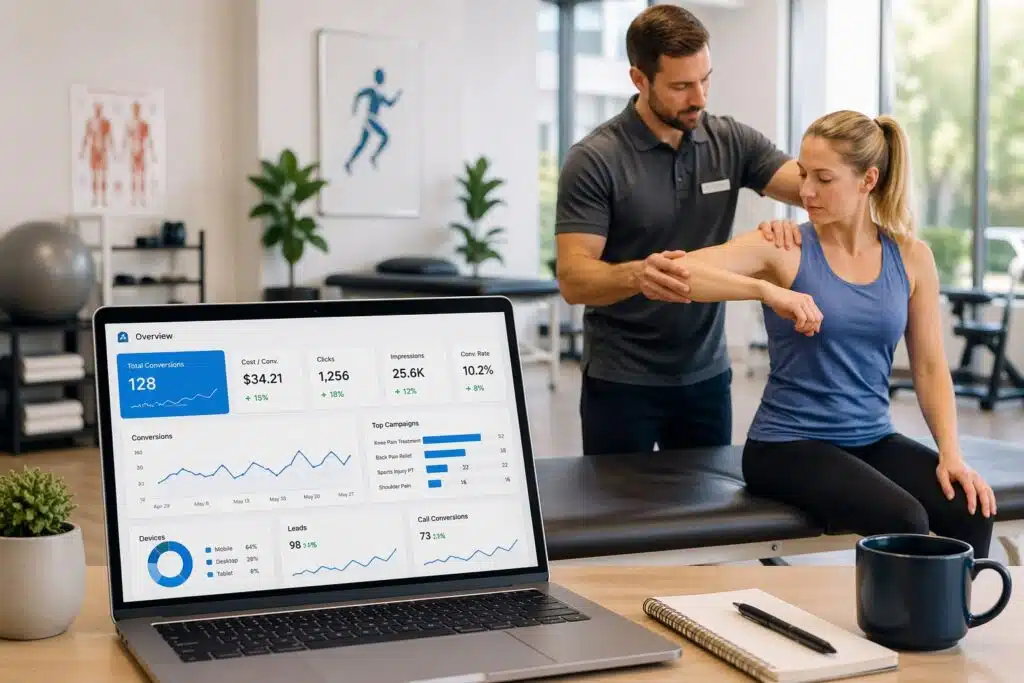
The metrics that matter for PT advertising aren’t impressions or clicks; they’re leads and booked appointments. Here’s what to track from day one:
- Cost per lead: Knowing your cost per new patient helps you set realistic targets. Most local PT markets should aim for $20–$60 per lead.
- Cost per booked appointment: This tells you the true ROI of each campaign
- Call tracking: Which ads are generating phone calls, and from which keywords?
- Google Ads Quality Score: This affects both your ad rank and what you pay per click
- Conversion rate by landing page: If one page converts at 8% and another at 2%, you need to know why
Before you spend a dollar on ads, set up Google Analytics 4 and Google Ads conversion tracking. These are the baseline tools for every PT clinic running any kind of paid campaign.
Google Local Services Ads — The Underused Option for PT Clinics
Google Local Services Ads (LSAs) are different from standard Google Ads in one important way: you pay per lead, not per click. That distinction matters for PT clinics with tighter budgets, because you only pay when a potential patient actually contacts you.
LSAs appear above both standard Google Ads and organic results, and they display a “Google Screened” badge, a trust signal that carries real weight with patients making healthcare decisions.
To qualify, PT clinics need to pass a background check process through Google. It takes some setup time, but the payoff is worth it: typical lead costs range from $20–$80 depending on your market, which is competitive with what most clinics pay on traditional search campaigns.
The best approach is to run LSAs alongside standard Google Ads, not as a replacement. They target slightly different search behaviors and together give your clinic maximum visibility at the top of the results page.
A Note on Healthcare Advertising Compliance
Before running any PT ads, you need to stay within healthcare advertising rules. This protects your clinic and keeps your campaigns running without issues.
Here’s what to watch out for:
- Patient testimonials: Using real patient stories in ads requires explicit written authorization. This applies to video, photos, and quoted text. Skipping this step creates HIPAA exposure.
- Outcome language: Avoid phrases like “cure,” “guaranteed results,” or “eliminate your pain.” These claims can trigger ad rejection on Google and Meta, and they create legal liability. Stick to factual, benefit-oriented language like “reduce pain,” “improve mobility,” “get back to doing what you love,” etc.
- Meta’s Special Ad Category: Facebook and Instagram classify certain health-related ads under their Special Ad Category, which restricts audience targeting options. PT clinics should be aware that some demographic and interest-based targeting may be limited.
For ongoing compliance review, working with a healthcare marketing specialist who knows PT-specific regulations is the safest approach.
Frequently Asked Questions
Why Digital Advertising Works Differently for PT Clinics
Physical therapy patients usually do a search when they are in pain or recovering from an injury. That means their intent is high, and they often want help quickly.
Because of this, search-based ads tend to perform better than general awareness campaigns. When someone looks for treatment, showing up at that moment gives you a much better chance of getting the booking.
Should You Work With an Agency for PT Advertising?
Running PT ad campaigns is not just about setting up ads. You also need to manage compliance, track results, and adjust campaigns based on what is working.
An agency that understands physical therapy marketing can help with:
- handling HIPAA-related considerations
- planning around seasonal patient demand
- building campaigns that match how patients search and book
This helps you avoid wasted spend and get better results from your budget.
See What Your PT Ad Campaign Is Missing
If your current ads are not bringing in consistent bookings, the issue is usually in the setup, not the platform.
Practice Promotions helps physical therapy clinics build campaigns that attract the right patients, track real results, and turn clicks into booked visits.
✔️ Get a free ad campaign review
✔️ See where your budget is being wasted
✔️ Find new opportunities to grow your clinic
👉 Book a strategy call today and see how your campaigns can perform better.