










How do you communicate the difference between physical therapy and occupational therapy to patients?
Even harder – how do you market your pediatric therapy practice in a way that’s understandable to scared parents?
Neil Trickett, CEO of Practice Promotions, chatted with Kristen Masci. She shared practical insights on how to grow organically. Kristen founded the Skills on the Hill pediatric therapy practice 19 years ago out of her basement. Today, the clinic is located in two locations and has 40 staff members to help ensure client needs are met at all times.
Here are a few suggestions and tips given by Kristen on how to go about pediatric physical therapy marketing.
Market to Parents and Children
Kristen: Pediatric therapy marketing is 50% about the child and 50% about the parent. Treat every parent as if they are the patients by extension, look inwards and reflect on the key points you would look for in a clinic for your child.

I gained a new insight when I was working with your team at Practice Promotions when we were rebuilding our website. Therapists attempt to come off as experts in the field and use medical jargon, sending parents into a frantic search on Google. Parents just want their child to talk or walk — they’re not always interested in fancy explanations or jargon. Speech and physical therapy are easier to explain because it involves speaking and walking, but not OT.
Seize moments like these to sell your compassion and willingness to make their lives easier. Get out of your therapist mode, forget the clinical jargon, and target the keywords a parent would look out for. Parents at this stage are more preoccupied with what they did wrong, especially if the medical diagnosis sets their ward on course for a future of continuous therapy, support or special attention.
Other qualities that will score you positive marks in parents’ books are:
- Listen to parents’ complaints and fears
- Be sensitive to their plight
- Validate their concerns and how hard it can be

These qualities make them feel safe and have your undivided attention, which sets the foundation for their listening to you, trusting your judgment and wanting to go with your practice.
Neil: Yeah, absolutely. Wonderful way of viewing that; that’s the secret sauce to any marketing if you can get into the customer’s head. With pediatrics, not only are you helping the child, but as you mentioned, the parents are making the decisions. I’m a parent of three kids, and I can imagine these parents want the best for their children. Because they have no medical background, the doctor’s or pediatrician’s information is nothing to play with.
Given that pediatricians’ schedules can be a mess with very little time to fully explain the diagnosis, these parents resort to Google for information. That is your opportunity to connect with this curious guardian. Your website articles, blog content or emails should target these types of parents. Who knows, you just might speak to what that parent might be going through.
You can be like, “Hey, we meet parents all the time that are frustrated, angry or feel guilty…” Saying these things gives them the feeling that they are not alone. Offer solutions and speak to their needs, like assuring them that you can help their child have a better future.
Kristen: Another reason parents are so important is that if they are satisfied with and value your services, they become free marketers. Their success stories can be all the convincing another parent needs to visit your clinic.
Also, it’s essential to slow down on the first evaluation. You have to think about the goals of the parent. The goals might not be realistic; they may not be achievable within six months or a year, but addressing the parents’ goals is vital. When it appears like the parent’s goals come from a place of inexperience, it is your job to educate them.
Do not be too firm about the correction. If you are not creative about it, you may come off as demeaning or harsh. This may tarnish the image and reputation of your practice.
Neil: You are speaking about a very important point that applies to every business and clinic. And, I would say, from my observation, being too firm and having mismatched goals are the primary reason people discontinue therapy.
Patient dropout is a huge problem. Several financial obstacles make access to therapy harder — people have to pay for treatment because their insurance barely covers it. Being at different points in their expectation cycle only hastens their choice.
In the pediatric world, it’s a longer cycle of working with the patients, paving the way for a healthy relationship and building trust over time. But I can see when parents have goals for their children that are not attainable, and we have to modify those goals, which can sometimes be a difficult conversation.
Kristin: Yeah. That trust and value on the front end; that’s the ticket to attend. That’s the ticket to decreasing cancellation. Attendance won’t be a problem if they trust you and value what you do for their child.
Neil: Yeah, absolutely. Fantastic advice.
Become a One-Stop-Shop
Kristin: That’s what parents really want; they want one-stop-shopping; they want a collaborative model.
Neil: You’ve obviously worked super hard to get where you are today — and see your success, from being in your own basement to two locations with 40 staff. It’s a tremendous accomplishment. As a business owner and therapist, there are obviously different obstacles along the way.
Many of those are similar across the whole spectrum of therapy. Especially if you are going to practice, you have to go through the same levels of challenges as business owners do.
Kristin: Yeah.
Neil: But that’s amazing, to be able to provide enough services. You had a great takeaway when you mentioned you didn’t think you would incorporate another discipline into your services, right? You took that leap; you saw that there could be a need there. I think you were looking at it from a customer viewpoint.
It’s something that we definitely see here at Practice Promotions that there are clients that are multidisciplinary. Along with pediatrics or their other core practice, clients bring in acupuncture, massage or other complementary disciplines. Creating a pediatric physiotherapy marketing strategy requires a deep understanding of the needs of the patients and the community.
People go to clinics with many different things to offer, especially a pediatric clinic, because the children have multiple needs for therapy. And so, they don’t want to come for one thing and then go to another place for another service. You saw that, right? And you took that initiative and realized there is a great opportunity here to provide more to the customer.
Kristin: Yeah, even within the therapy disciplines, also looking at how we can offer different services that are unique and make us stand out. You know, services that other practices are not offering because that makes you more sought after.
We have strong summer programming to compensate for losing all the school services in the summer. The program is important because the kids we work with cannot attend regular summer camps. We’ve been doing that for years.
Another thing is feeding therapy. We have occupational and speech therapists doing feeding therapy, a specialty area some other practices don’t have. Two newer editions are aquatic therapy and adaptive swimming. We have some swimming instructors with special training handling that specialty. The service is near impossible to find.
The last unique service we offer is assistive and augmentative communication (AAC). Within speech, many non-verbal children need a means of communication. To prepare for and attract these patients, we have provided a lot of training for speech therapists.
Neil: Awesome, fantastic. And I think you’ve shown how to dial customer needs within your plans. That’s really smart. So, for all our clients that have outpatient clinics, you see these different needs come in, and what can you build around these models that people would go for.
Don’t Forget About Google
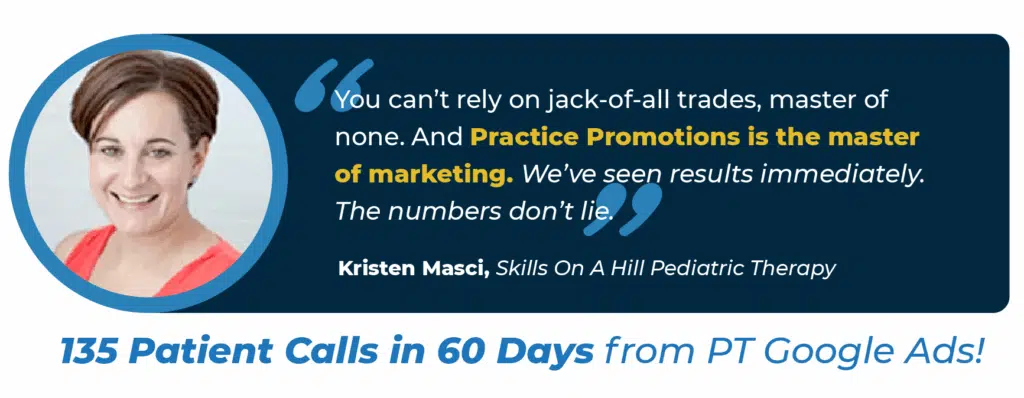
Kristin: Working with Practice Promotions has made me understand and appreciate that you all are specialists. I wouldn’t call what we were doing before a waste of money, but it showed us why targeted solutions were much better. We’ve seen results immediately. We struggled for a while with search engine optimization (SEO), because once you change your website or the platform on which it was hosted, you start at the bottom of the SEO ladder. Practice Promotions has really helped that on the back end.
Neil: It’s really about helping you get in front of the right amount of people — there are tons of people looking for help. Many things on the backend help you get there when you connect the right messaging to that.
So Kristin, any final thoughts here for our audience?
Kristin: Google is an essential part of the whole process. Getting those visits to your website is so important. I love how Practice Promotions creatively used Google Ads to support our organic traffic, coming at it from two angles.
We have monthly reports and quarterly calls. I love how the report is a video; I can just play it whenever I need to. The stats are increasing dramatically, and your team has been great to work with. I am assured that they respond very quickly if I need something or have questions.
We’ve had to be creative because we’re a pediatric practice with three service areas. Your team has been happy to think outside the box with me and change things up a little. If something’s not working? Change it. It’s been an incredible journey, and I’m looking forward to pushing forward and utilizing more of the tools PP offers.
Contact Practice Promotions For Your Pediatric Occupational Therapy Marketing Needs
Many people would rather interact with you and visit your practice because of your personality and how you interact with them. Practice Promotions handling your clinic marketing needs with the right content and success in interacting with new patients will help your business grow organically, initiate potent word-of-mouth marketing and improve patient numbers. Call us at (844) 907-0321 for your samples and pricing inquiry.