











Marketing often gets treated like a “nice-to-have” expense, something to cut when cash flow feels tight. But in reality, the right physical therapy marketing budget is what protects your practice from slow seasons, no-show gaps, and burnout caused by unpredictable volume.
This guide will help you build a marketing budget that PT practice owners can actually rely on. We’ll break down the 7–8% benchmark, explain when it makes sense to spend more (or less), and show you two proven ways to calculate a marketing budget for PT owners based on revenue and goals.
If you want guaranteed growth, it starts with budgeting like a business owner, not just a clinician.
The Golden Rule: The 7–8% Revenue Benchmark
If you’ve ever wondered what a “normal” marketing spend looks like, here’s the simplest starting point:
Many healthy small businesses allocate 7–8% of total revenue to marketing.
That baseline is often referenced in small business budgeting standards and gives PT owners a practical benchmark to work from.
The Simple Formula
Total Monthly Revenue x 0.08 = Your Monthly Marketing Budget
So if your clinic brings in $80,000/month, your marketing budget would be:
$80,000 x 0.08 = $6,400/month
That doesn’t mean you must spend exactly 8%. But it gives you a target that’s grounded in reality, not guesswork.
The “Maintenance vs. Growth” Scale (Quick Guide)
A smart physical therapy marketing budget depends on whether you’re trying to maintain volume or actively grow.
Here’s a straightforward scale:
- 5% of revenue: Maintenance
Keeps you steady and helps prevent the “slow season dip.” - 7–8% of revenue: Healthy growth baseline
Enough to compete, stay visible, and keep schedules full. - 10%+ of revenue: Aggressive growth
Best when hiring new clinicians, opening a new location, expanding services, or trying to dominate a competitive market.
If your goal is predictable patient volume and a stable team, most practices do well in the 7–10% range, depending on growth stage.

3 Factors That Influence Your PT Marketing Spend
The “right” marketing budget for PT owners is not one-size-fits-all. Two clinics can have the same revenue and need totally different marketing spend based on what’s happening inside the business.
Here are three factors that should shape your budget.
1) Your Practice Lifecycle
Your clinic’s stage matters.
Startup clinics (0–18 months):
You’re building awareness from scratch. That typically requires a higher spend, often 15–20%, because you don’t have momentum yet.
Established clinics:
Once you have reviews, referral relationships, local rankings, and consistent word-of-mouth, you can often operate effectively at 7–8%, as long as you’re not trying to expand aggressively.
If you’re established but still feeling inconsistent month-to-month, it may not be a “bad market.” It may be a budget that’s too low to keep the referral engine running.
2) Capacity and Efficiency
Here’s a simple truth most owners avoid:
If you have open schedule gaps, your marketing budget is currently too low, or your marketing system is underperforming.
Empty tables, idle clinicians, and inconsistent weekly volume usually mean one of two things:
- You’re not investing enough to drive demand
- You’re investing, but into channels that don’t convert
Marketing is not about “being visible.” It’s about filling schedules with the right patients consistently.
3) Competitive Landscape
Competition changes everything.
If three big-box clinics or corporate chains enter your area, your budget needs to respond. Not forever, but at least long enough to protect your market share.
In competitive zip codes, marketing becomes defensive as well as growth-focused. You’re not just trying to grow. You’re trying to avoid losing volume you already earned.
If your competitors are investing heavily in Google Ads, SEO, and reviews, a 1–2% budget is not going to keep you in the game.
The Two Ways to Calculate Your Budget
Most PT owners use one of these two methods. The best clinics often use both.
Route A: Percentage of Revenue (The Easy Way)
This is the simplest and most common method.
Revenue x 7–8% = marketing budget
This works best when:
- Your revenue is stable
- Your clinic has a predictable capacity
- You want steady, consistent growth
- You’re not aggressively scaling
It’s easy to manage and gives you a reliable baseline without overthinking it.
Example:
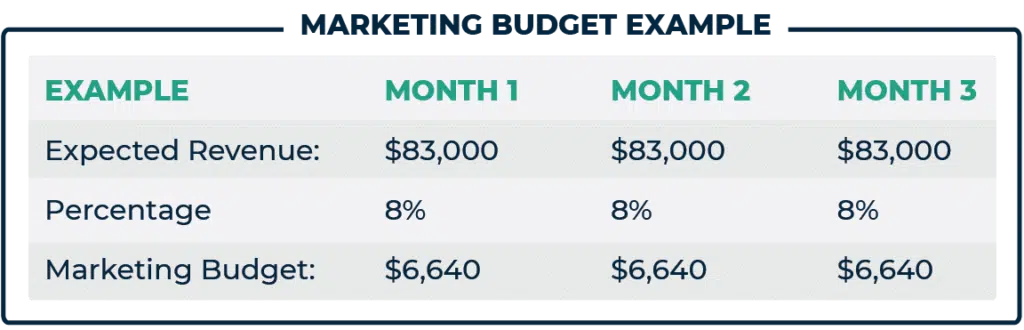
A clinic doing $1,000,000/year (about $83,000/month) would budget:
$83,000 x 0.08 = $6,640/month
That budget would cover a realistic combination of local SEO, paid ads, reactivation campaigns, and retention marketing.

Route B: Objective-Based Budgeting (The Pro Way)
This is the smarter, more performance-driven method.
Instead of starting with revenue, you start with outcomes:
“How many new patients do I want each month, and what will it cost to get them?”
Here’s the logic:
- You want 20 new patients per month
- Your cost per acquisition (CPA) is $100 per new patient
- Your budget needs to be $2,000/month
20 patients x $100 CPA = $2,000 marketing budget
This approach is powerful because it turns marketing into a measurable system, not an expense.
It helps you answer questions like:
- How many new patients do we need to hire a new PT?
- What budget is required to hit that number?
- Which channels actually drive conversions?
If you want “guaranteed growth,” this method gives you the closest thing to a predictable formula.
The Danger of the “1% Budget” (The Underspending Trap)
Many practice owners spend 1–2% of revenue on marketing. It feels responsible. It feels conservative.
But it often creates a long-term problem: your clinic becomes stuck at the same volume year after year, with random spikes and frustrating drops.
The “Slow Death” Cycle
Underspending leads to:
- inconsistent visibility
- inconsistent leads
- inconsistent evaluations
- inconsistent schedules
- staff stress and turnover
- owner burnout
When schedules are not full, your best clinicians notice. And good clinicians don’t stay long in a clinic that feels unstable.
The Real Cost of Underspending
The most expensive marketing mistake isn’t overspending.
It’s saving $2,000 on marketing and losing $20,000 in patient revenue.
Because when a clinic is under budgeted, it’s not just losing leads. It’s losing:
- downstream plan-of-care revenue
- retention and reactivation opportunities
- long-term referrals
- growth momentum
If your clinic has capacity and you’re spending 1–2%, you’re not “saving money.”
You’re paying for unpredictability.
Where Should the Money Go? (Strategic Allocation)
Once you’ve calculated your physical therapy marketing budget, the next question is where to put it.
The best marketing budgets aren’t just bigger. They’re smarter.
Here’s a proven breakdown.
Internal Marketing (Low Cost, High ROI)
Internal marketing is often the fastest way to increase volume without spending heavily on ads.
Examples include:
- Reactivation postcards
Bring back past patients who still need care. - Email newsletters
Keep your clinic top-of-mind with your community. - Referral programs
Encourage word-of-mouth from patients, physicians, trainers, and local partners. - Patient retention systems
Reduce drop-off, improve plan-of-care completion, and increase outcomes.

Internal marketing is usually low-cost, but high-impact because you’re targeting people who already trust you.
External Marketing (Scalable Growth)
External marketing is how you consistently add new patients and expand market reach.
Examples include:
- Google Ads (PPC)
Fastest way to generate leads in many markets. - Local SEO
Builds long-term visibility for searches like “physical therapy near me.” - Community workshops and partnerships
Great for trust-building and steady referral flow.
External channels are scalable, but they must be tracked. If you don’t know your CPA, you can’t control your budget.
The 80/20 Rule for Smart Clinics
A simple way to stay focused:
- 80% of your marketing budget goes to proven channels
(Local SEO, Google Ads, high-performing campaigns) - 20% goes to brand-building and experimentation
(social media, community events, awareness content)
This prevents you from wasting money on strategies that feel productive but don’t actually fill schedules.

Conclusion: Taking the Stress Out of Marketing
A marketing budget is not a restriction.
It’s a permission slip to grow.
When you know what you can spend, where it should go, and what results you expect back, marketing becomes a predictable system. Not a monthly stressor.
To recap:
- Start with the 7–8% revenue benchmark
- Increase to 10%+ when you’re hiring, expanding, or competing aggressively
- Use objective-based budgeting when you want predictable new patient volume
- Avoid the 1% underspending trap that creates long-term instability
- Focus your spend on channels that consistently produce evaluations
If you want a fast next step, do this today:
Take last month’s total revenue and multiply it by 0.07 or 0.08.
That’s your baseline marketing budget.
Then compare it to what you actually spent.
If there’s a gap, your growth is likely being limited by budget, not effort.

Get a PT-Led Marketing Team That Knows How to Grow Clinics
Want help building a marketing budget that actually turns into consistent evaluations and a fuller schedule?
Practice Promotions is run by physical therapy experts, so we understand what clinics of every size need to grow without wasting money. From physical therapy website design and local SEO, to social media marketing and patient leads analysis, we help you invest with confidence and track what’s working.
Schedule a strategy call today and see what a predictable, performance-driven marketing plan looks like for your clinic.