






What are the biggest problems physical therapists face in 2023? What is the state of the physical therapy industry? And what role does physical therapy marketing play in it?
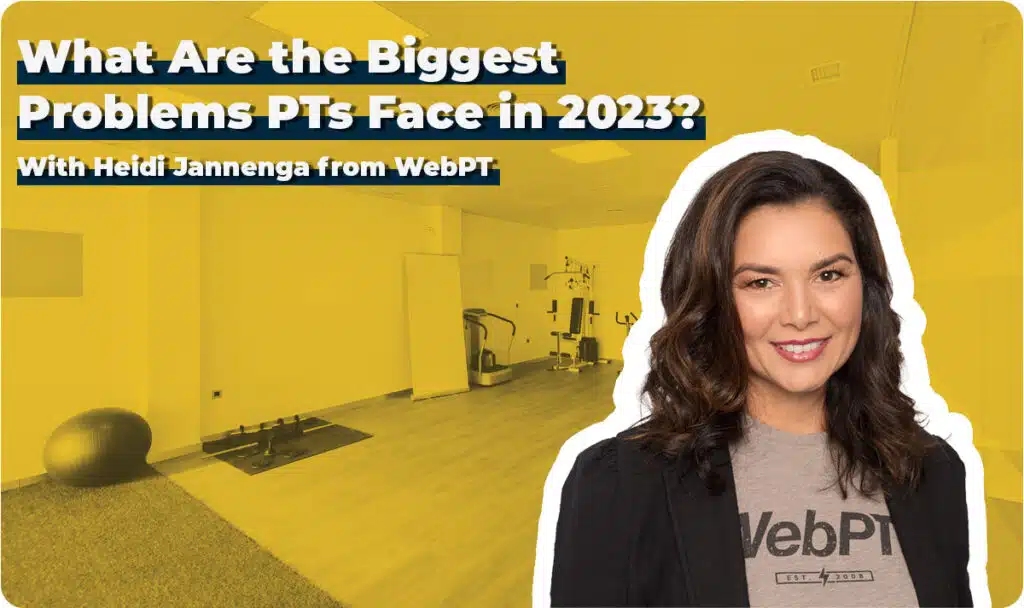
To find the answer to those questions, Practice Promotions CEO Neil Trickett interviewed Heidi Jannenga, co-founder of both WebPT and Rizing Tide, to find out.
Rehab Report: Implications for Physical Therapy Marketing
Neil: Let’s just talk about WebPT’s State of Rehab Report. Seven thousand people participated in that, so we have a good idea of what are some of the many challenges out there. Can you talk to us a little bit about some of the major findings from that report?
Heidi: I’ll just preface it by saying that the survey was given out at the end of 2021 to 2022. Obviously, coming out of 2021, we were still just coming out of the COVID atmosphere.
One of the things that we noted was that there was actually a big disconnect between leadership and the workforce, the therapists, and the front office staff.
- Almost 30% of those that answered the survey said that they’re considering a professional change because they’d like more flexibility in their work schedule.
- And then contrary to that, we have leaders who are saying — almost 30% of them – said that they haven’t actually done anything when it comes to changing or updating or even thinking about the retention strategies overall.

WebPT, State of Rehab Report 2022
Heidi: Such a difference.
We noticed this even anecdotally with WebPT, too. We’ve had more therapists who have applied for positions with WebPT in a non-clinical role than we’ve ever had in the whole entire existence of our company put together.
The Role That Salaries Play in This Equation

Heidi: Clinicians are ranking salaries as a driver for resignations, but actually, what the workforce is saying is that they’re really looking for more reasons for engagement.
It’s all about this happiness that we started this conversation with, right?
- How do I be engaged?
- How do I feel like what I’m doing matters?
And that’s really incumbent on leadership to focus more on the purpose of your business and the purpose of what you’re trying to do, rather than the nuts and bolts and the mechanics of how to get it done.
So…
- How do we understand internal communication?
- How are we resolving concerns?
- Are we working to get everybody engaged again at a level that were pre-COVID levels?
How Empowering Employees Improves Your PT Marketing
Neil: I think one thing that I got from the Rehab Report that I thought was fascinating was that overall employee turnover is affecting more than half of rehab therapy organizations in some capacity.
However, as the organizations grow, the number increases significantly, reaching as high as 89%. My takeaway was that the bigger and more complex your practice becomes, the higher that percentage is. Is that what the report was telling us?

WebPT, State of Rehab Report 2022
Heidi: Yep. That’s essentially what we were saying. Or at least, the data’s telling us. From those that answered, we know that there’s a lot of burnout. We know that patient volumes have soared to 20 patients per therapist per day in some practice settings.
Again, it’s really going back to some basic leadership principles. When you’re bigger, it’s much harder to connect sometimes and to communicate.
Something we’ve always preached is really teaching everyone in the business how they contribute to the business.
- Where does my salary come from?
- How do I generate more revenue?
- How do I improve my efficiency?
- How do I embark on something that’s really interesting that I love to do?
Really simple things that maybe you do in your personal life that can actually be brought together with your professional or clinical personality if you will.
For example, if you have an affinity towards marketing…
- How do I help with our social media?
- How do I help with getting more leads in the door, getting more patients in the door with something I love to do that may not only be about my patient care?
Or…
If you have a therapist who’s really into running, for example…
- How do they incorporate a running program that can now be a part of your practice?
- How do you now engage their whole running community?
- How do you bridge that gap between you and that community within your clinic?

When you really combine those things together, that’s when you really get the engagement of that whole person. At the end of the day, that’s what you really want.
Also, just knowing the metrics of your business is important. You know your pay-per-visit and your cancel/ no-show rate. Just some basic ones.
It’s amazing how just a few percentage points can really change what you’re able to do because you’re improving your top-line revenue.
Giving Physical Therapists Their ‘Why’
Neil: People are willing to do things that they understand the why, right? We’re here to help people, but we’re also a business, and we want to give people opportunities – I think that’s one of the great words to use when you’re talking to your staff – opportunities.
- You want opportunities for better growth?
- You want opportunities for better salaries?
- You want opportunities for CE courses?
We can fund that if you’re properly billing for your time. Your time is valuable. You’re a great therapist, and you should be appropriately paid for your services. We deal with this insurance world. We have to know how to work within it.
I think if you approach it from that angle, it’s not a dirty thing. It’s actually an important thing. I think that many practice owners don’t do enough of that education, which can make a significant difference in the way they’re billing and obviously, help them a lot with their revenue.
The Role Mentorship Plays In Your PT Clinic’s Success
Neil: Have you seen more clinics start to incorporate mentorship programs within their clinical offerings?

Heidi: Yes. And also affiliations with residency programs. You mentioned Rizing Tide, which I’m very proud of. Rizing Tide is a scholarship program specifically for BIPOC DPT students and also residents.
As we’ve gone through hundred of interviews now for our scholarship program, one of the biggest light bulbs going off for me is this want for mentorship, and they don’t feel like they get in PT school.
That is why 90% of our students go onto a residency program… They want mentorship. In one student’s words: It was that they didn’t want to learn by trial and error.
They wanted to have the tools in their toolbelt to really help their patients to their maximum ability. They didn’t necessarily feel like they could do that right out of school.
Helping Small PT Clinics Set Up Mentorship Programs
Neil: Understanding that a good chunk of our market tends to be a bit smaller to mid-sized clinics that might have multiple practitioners but within a single location, how did they approach being able to have this kind of mentorship in order to attract people and retain people?
Heidi: Great question! It really takes some clear intention to really build a program in which you have people who are maybe more seasoned, who maybe have gone through residency programs themselves, or have gone to a specialty certification, to want to be leaders in terms of mentorship program.
And then, through your recruiting, it’s really recruiting people who have the potential… Take an inventory of all the people you have who have the potential to mentor.
Last Thoughts on Physical Therapy Marketing in 2023
Neil: What final thoughts do you have for our audience here, a few things that they could put their focus on for the next year?
Heidi: I will just say that with the economy where it is, it’s going to be a little bit tough in the early stages of 2023.
When people are tight with their wallets, it always affects us as a profession a little bit. Their length of plans of care may be shortened, or they just struggle with having to pay their copay or deductible, especially at the beginning of the year, so just be prepared for that.
That’s first and foremost.
Second, is that we have had a lot of therapists leave the industry. I’m sure that many of you are struggling, perhaps right now, have open reqs for a PT, or you just can’t seem to find a PT who wants to work full-time without getting paid as full-time right now.
It’s a dilemma that’s not unique to you. It’s happening all across the country. It is really about getting more creative now in providing more flexibility with schedules, engagement with the practice and also just leadership opportunities that allow them to feel ownership in what they’re doing.
I guess those would be my only final words of advice outside of: Don’t give up hope. We know that nothing is going to replace us in terms of our hands-on skills and the knowledge that we get from our PT programs.
Put those in action. Be vocal. Become an advocate for yourself, for your clinic, but also for the profession.
Get involved with the PT PAC. Be involved with advocacy in your local area and your association. It is all super meaningful to the overall future of our profession.
If you’d like to hear the full podcast in detail, go to the PT Marketing Power Hour podcast!