










Many PT owners find themselves wasting valuable resources on ineffective marketing strategies because they chose the wrong agency.
In this post, we’ll break down seven major red flags to watch for when hiring or re-evaluating a PT marketing agency. These signs indicate that you might be losing money and missing out on new patient evaluations, even if you don’t realize it yet.
1. Reporting Vanity Metrics Instead of Meaningful Results

Many marketing agencies track “vanity metrics”—numbers that look impressive but don’t necessarily translate into real growth. These might include impressions, likes, shares, or clicks.
While these metrics can show some level of engagement, they don’t tell you anything about whether potential patients are booking appointments or visiting your clinic.
What You Need to Track
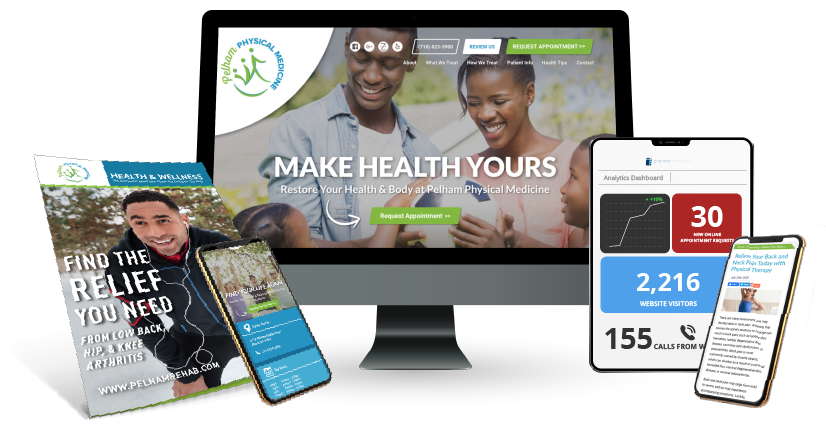
For a physical therapy clinic, the only metrics that matter are patient visits and cost-per-lead. You should see actionable data like:
- appointment requests,
- call-to-action (CTA) clicks,
- or how many people are reaching out for consultations.
These are the real indicators of marketing success, not just engagement metrics that may or may not lead to any measurable return.
An agency focused on the wrong metrics is unlikely to have your best interests in mind. Be sure that they track the actions that matter most—those that directly impact your clinic’s bottom line.
2. Lack of Understanding of the Direct Access Patient Journey

In today’s healthcare landscape, many patients are bypassing physician referrals and directly seeking out specialists through online searches. Well above 70% of them, in fact.
This shift in the patient journey is especially important for physical therapy clinics, where potential patients are increasingly searching for terms like “back pain relief” or “sciatica specialist” rather than relying solely on referrals from a physician.
If your marketing agency is focused only on physician referrals, they might be missing a key opportunity.
Understanding how patients navigate the healthcare system today is crucial.
- Your agency should be skilled at optimizing your digital presence for “direct access” keywords—search terms that help patients find your clinic without needing a referral.
- A successful marketing strategy for PT clinics needs to emphasize local SEO and patient-centric content that attracts people directly to your practice.
If your agency doesn’t understand this concept, they could be setting you up for missed opportunities.
| How Practice Promotions Captures Direct Access PatientsMany agencies still market physical therapy clinics as if physician referrals are the only growth lever. Practice Promotions is built for how patients actually find care today.Our PT-specific SEO and digital marketing services are designed to:Capture direct access searches like “back pain relief,” “sciatica treatment,” and “sports injury physio” Rank clinics in the top local results for high-intent physical therapy keywords Convert website visitors into real appointment requests, not clicks or impressions Track leads in a HIPAA-compliant way, tied directly to new patient evaluations Scale from single-location clinics to multi-location practices with 6+ therapists This is not generic SEO. It’s a physical therapy growth system built around patient behavior, local intent, and measurable outcomes.👉 Explore Physical Therapy Digital Marketing |
3. Lack of Ownership Over Your Website and Data

One of the biggest red flags to watch out for is an agency that withholds access to your website or digital accounts. You should alwayshave full ownership and control over your digital assets, including your website, Google Ads account, and Google Analytics.
Why It Matters
If you can’t access your website or marketing data, it’s like being locked out of your own practice’s growth strategy. Without this control, you’re at the mercy of the agency, and any transition to another provider could become unnecessarily complicated.
You should never have to go through an agency to access your own website’s backend or advertising accounts.
If the agency is reluctant to provide you with login credentials or makes excuses for why they need to maintain control, it’s a significant red flag. An agency that truly partners with you will ensure you have full transparency and control over all your digital assets.
4. Using Generic Templates for Your Content

Content is a critical part of any digital marketing strategy, especially for a niche service like physical therapy. However, some agencies usegeneric templates for content such as blog posts or condition pages. This is not only ineffective for SEO, but it could also hurt your clinic’s credibility in the eyes of both Google and potential patients.
The Risks of Using Templates
If your agency’s content looks identical to your competitors’ three towns over, you risk receiving a Google penalty for duplicate content.
Additionally, patients who encounter generic, cookie-cutter content may feel that your clinic isn’t specialized enough to meet their needs.
- A skilled PT marketing agency should provide custom, high-authority content specific to your practice.
- They should focus on creating well-researched articles, condition pages, and blog posts that align with your clinic’s services and your patients’ needs.
Original content that addresses your patients’ pain points will not only help improve your SEO rankings but also enhance your clinic’s reputation and credibility.
5. No Proven Process or Strategy for Physical Therapy Clinics

Some agencies treat physical therapy clinics like any other business, applying generic strategies that may not be effective in the healthcare sector. The lack of a specialized process could lead to wasted resources and ineffective campaigns.
What a Proven PT Process Looks Like
A good PT marketing agency should have a defined process in place. For example, many successful agencies will have an “onboarding” phase where they evaluate your clinic’s current marketing efforts, set clear goals, and develop a customized plan.
This might include an 8-week kickstart program, where the agency refines your website, improves your SEO, and sets up tracking for conversion metrics.
Without a structured and proven process, you’re essentially letting the agency experiment with your marketing budget.
A specialized agency will be confident in their ability to get results because they’ve done it before with other PT clinics.
Look for a partner that has a proven track record in the physical therapy industry and offers a strategic, transparent approach to growth.
6. Focusing on “Viral” Marketing Instead of Long-Term Growth

The allure of “viral” marketing is strong, especially in the age of social media, but the truth is that viral campaigns rarely translate into sustainable business growth. For a physical therapy clinic, it’s the long-term, consistent marketing strategies that will pay off, not a one-off viral campaign that garners temporary attention.
What Works for PT Clinics
Search engine optimization (SEO), Google Ads, and localized content are the strategies that bring consistent, qualified leads to your clinic.
These tactics target patients who are actively searching for physical therapy services in your area and are ready to take action. Investing in these long-term strategies ensures that your clinic remains visible to patients who need your services, long after the viral campaign has faded from memory.
If an agency is pushing viral campaigns or focusing too much on TikTok and Instagram influencers, it’s a red flag. While social media can play a role in patient engagement, it should never replace proven, long-term marketing tactics that consistently bring in new patients.
7. Outgrowing Your Agency’s Capabilities

As your clinic grows—whether by adding more therapists or expanding to multiple locations—your marketing needs to evolve. If you’re still working with an agency that treats you like a small business, you might be outgrowing their capabilities.
Your agency should be able to scale their efforts to meet your growing needs.
What Scaling Your Marketing Looks Like
For a multi-location PT clinic or one with 6+ therapists, the marketing strategy should evolve to include:
- advanced tracking,
- multi-location SEO,
- and lead management tools.
Your agency should be equipped to handle high-volume lead generation and conversion tracking, ensuring that no potential patients slip through the cracks.
If your agency is treating you like a small clinic and not adjusting its strategies to match your growth,it’s time to find a partner that can scale with you. Look for an agency that has experience working with larger practices and can provide the resources necessary to manage your expanding business.
2026 Checklist: Is It Time to Switch?
Before signing a new contract or switching agencies, use this checklist to evaluate whether your current marketing partner is the right fit for 2026:
- Do they offer HIPAA-compliant lead tracking?
- Do they have a dedicated account manager who understands the physical therapy industry?
- Can they show a proven ROI of 5:1 or higher for their PT clients?
- Are they transparent about their marketing process and strategies?
- Can they demonstrate a clear understanding of the local market and patient needs?
- Do they understand the “Direct Access” patient journey?
- Are they transparent about their pricing and deliverables?
- Do they have experience with scaling multiple locations or teams?
- Do they have a proven process for onboarding new clients?

Conclusion: You Deserve Better Results
Hiring the wrong agency can drain your marketing budget without delivering the results you need. When you’re looking for a partner to grow your clinic, don’t settle for “good enough.” In 2026, make it the year you stop wasting time and money on agencies that don’t understand your business and its unique needs.
Ready to take your clinic’s marketing to the next level?
Book a free PT marketing strategy call today, and let’s discuss how we can help you achieve sustainable growth in 2026.
References:
- Phillips, Lisa. “How Consumers Shop Online for Doctors.” EMARKETER, 9 Mar. 2023, www.emarketer.com/content/how-consumers-shop-online-doctors. Accessed 18 Feb. 2026.
- Salsi, Hava. “Duplicate Content: SEO Best Practices to Avoid It.” Semrush Blog, 22 Dec. 2023, www.semrush.com/blog/duplicate-content/.