











As a physical therapy practice owner, time is your most limited resource.
Most clinic owners begin their journey wearing a single hat, the clinician. Over time, that role expands to include CEO, manager, marketer, employer, and leader… The challenge is that many owners continue running their schedule like a treating therapist, even when the business demands strategic leadership.
This is where time management for physical therapy owners often breaks down. It is treated as a soft skill rather than a business system.
Why Our Framework Works?
The reality is simple. If your time is not intentionally structured, your practice growth stalls, your stress increases, and your personal life pays the price.
The goal of this framework is to help you reclaim control of your schedule using proven principles that allow you to balance patient care with CEO-level decision making. When applied correctly, these strategies can free up ten or more hours each week for growth, family, and recovery.
1. Categorize Your Tasks Using the Eisenhower Matrix
One of the biggest mistakes PT owners make is treating all tasks as equally urgent. The Eisenhower Matrix helps you distinguish between what feels urgent and what actually drives long-term success.
Urgent tasks demand immediate attention. Important tasks move the business forward.
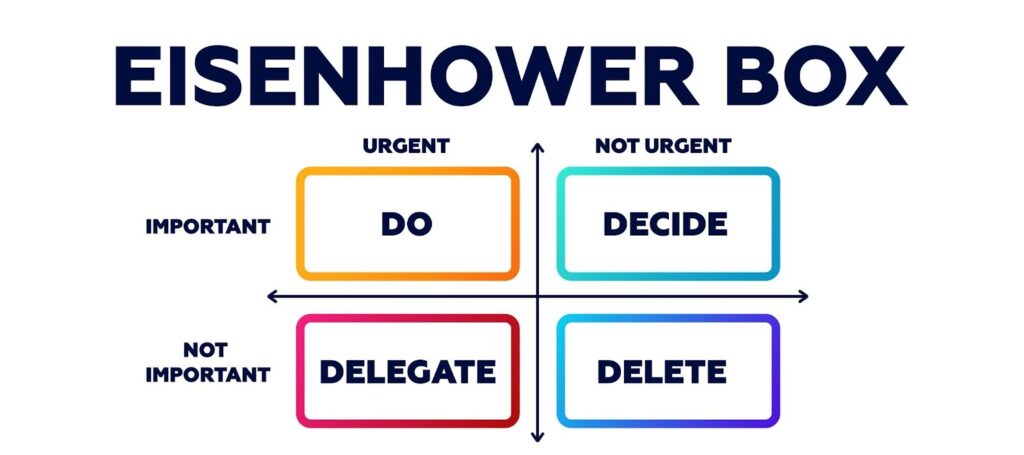
Eisenhower Matrix for PT Clinics
| Quadrant 1: Do (Urgent and Important)These tasks must be handled immediately and often cannot be delegated.Patient emergencies or cancellations that disrupt the dayPayroll deadlinesCompliance or insurance issues with immediate consequences | Quadrant 2: Schedule (Important but Not Urgent)This is where real growth happens, yet it is where most owners spend the least time.Marketing strategy and referral developmentStaff training and performance reviewsFinancial analysis and budgetingTime management and planning These tasks should be scheduled proactively rather than squeezed in between patients. |
| Quadrant 3: Delegate (Urgent but Not Important)These tasks feel pressing, but do not require your expertise.Front desk interruptionsInitial billing questionsRoutine scheduling adjustments Delegation here protects your focus and reduces burnout. | Quadrant 4: Delete (Not Urgent and Not Important)These tasks add noise without value.Excessive email checkingLow-impact meetingsPassive social media scrolling disguised as “marketing” Reducing Quadrant 4 work creates immediate time relief. |
2. Time-Blocking the Owner Hat
Effective time management for PT owners requires intentional separation between clinical and CEO responsibilities. Without boundaries, administrative work leaks into patient care, and strategic thinking never gets the space it needs.

Apply the 80/20 Rule
The Pareto Principle states that roughly 20 percent of activities generate 80 percent of results. In a PT clinic, this often includes referral relationships, pricing decisions, staffing, and marketing systems. These tasks deserve protected time.
Block a Dedicated Administrative Day
Choose one full day each week where you do not treat patients.
- No scrubs
- No patient sessions
- No reactive scheduling
On this day, you operate exclusively as the CEO. This single shift often creates more momentum than scattered admin hours across the week.
Align Blocks With Peak Performance
If your analytical thinking is strongest in the morning, schedule financial and planning work early. If you are more creative later in the day, reserve that time for marketing or content review. Time blocking only works when it respects your natural energy rhythms.
| 🎧 CEO Insight: What Running a $75M PT Practice Actually RequiresWhat does every CEO of a physical therapy clinic need to understand about time, leadership, and focus?In this Practice Promotions podcast episode, Neil sits down with Steve Anderson, DPT, former CEO of Therapeutic Associates, who grew the organisation into a $75 million physical therapy practice spanning more than 80 outpatient clinics across Washington, Oregon, and Idaho.In this episode, Steve shares practical insights on:Thinking like a CEO instead of a full-time clinician The value of enhancing staff’s leadership skills Avoiding leadership and staff bottlenecks with flexible work arrangements Listen to learn how high-performing PT CEOs protect their time while growing responsibly.LISTEN TO THE EPISODE |
3. The Power of Batching Administrative Work
Constant context switching is one of the fastest ways to destroy productivity. Jumping between patient care, emails, billing questions, and documentation drains mental energy and increases errors.

Why Context Switching Fails
Each switch forces your brain to reorient. Over a full day, these micro-interruptions compound into lost hours and reduced focus.
The Fix: Batch Similar Tasks
- Check email twice per day instead of continuously
- Review clinical notes in a single focused block
- Handle billing and insurance tasks in one scheduled session
Batching reduces mental fatigue and allows you to be fully present with patients when you are treating. This improves both efficiency and quality of care.
4. Strategic Delegation: Who Is Doing the $20 Tasks?
A useful mental exercise for practice owners is to assign a dollar value to their time. If your clinical and leadership work is worth $150 per hour, performing $20 per hour tasks becomes a costly habit.

Identify Immediate Delegation Opportunities
Common tasks that should be reassigned include:
- Appointment reminders and confirmations
- Social media posting and basic content updates
- Initial insurance verification
- Routine intake follow-ups
Delegation is not about doing less. It is about ensuring the right work is done by the right role.
Build a Practice That Runs Without You
The long-term goal of delegation is operational independence. Your clinic should function smoothly whether you are treating patients, working on strategy, or taking time off. This is a core requirement for scalability and eventual exit planning.
5. Building Sustainable Habits for Longevity
Time management systems for PT owners fail when they ignore the human element. Sustainable performance requires recovery, boundaries, and intentional transitions.

Rethink Self-Care
Self-care is not a reward for finishing work. It is a prerequisite for high-level decision-making. Chronic fatigue leads to reactive leadership and poor business choices.
Use a Commute Ritual
Create a short routine that marks the transition from practice owner to spouse or parent. This might be a short walk, a podcast, or a few minutes of quiet before entering your home. These rituals reduce emotional carryover and improve personal relationships.
Review and Adjust Weekly
Spend fifteen minutes every Friday reviewing the upcoming week.
- What needs to be scheduled
- What can be delegated
- What should be removed entirely
This simple habit keeps your system responsive rather than rigid.
Conclusion: From Busy to Productive
Effective time management for physical therapy owners is not about doing more. It is about doing the right things at the right time, with intention.
When your schedule reflects your priorities, your clinic can grow without consuming every hour of your life. The result is a business that operates smoothly, supports your team, and gives you the freedom to step back without fear.
If you want help building systems that support sustainable growth, patient volume, and leadership clarity, the next step is simple.
Book a strategy call with Practice Promotions to build a marketing and retention plan that brings in new patients, improves follow-through, and protects your time.